
By Eiliyah Naveed
April 13, 2026
Inside the Belief Bubble: Are We Trapped By Our Own Beliefs?
Research by F. Ece Özkan and Dr. Samuel Ronfard from UTM’s Childhood Learning and Development Lab asks an important question: When are humans most prone to myside bias?
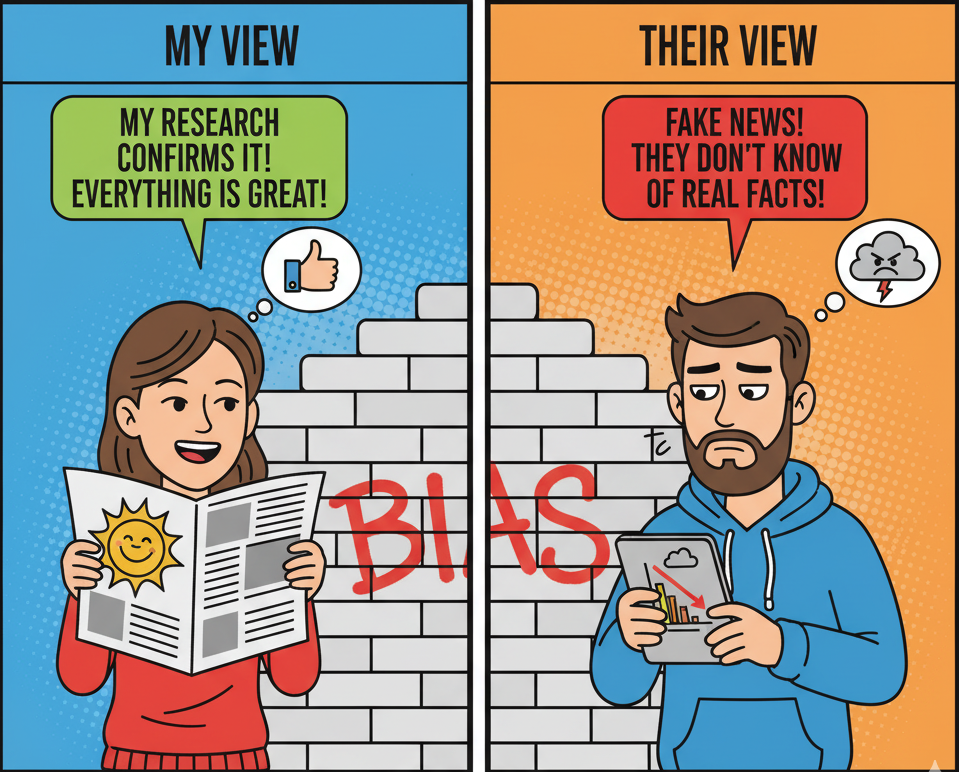
Myside bias builds a barrier where people favour their own beliefs and dismiss opposing ones. Photo Source: Google Gemini AI.
Imagine you have a relative who insists that therapy doesn’t work. They follow social media accounts that mock therapy, like the posts that say therapy is a waste of time, and ignore anything showing that therapy can improve mental health. Each click and share only strengthens their belief even further. They argue with you to prove that their point of view is correct. Does this sound familiar?
This is an example of myside bias, favoring information that aligns with what we already believe and ignoring information that contradicts our beliefs. Although this is common, new research has found that we are not always biased; it all depends on the context! Your relative has a strong bias because of an argumentative context – they’re trying to convince you that their belief is correct. When they have to justify their reasoning to you, their search for information becomes more biased; they keep reading articles and blogs that reinforce their belief, while ignoring counterevidence showing the benefits of therapy. Research also suggests that this bias intensifies with age! So, an older relative of yours will likely show stronger bias than a younger relative.
F. Ece Özkan (a doctoral student) and Dr. Samuel Ronfard in the Childhood Learning and Development Lab at the University of Toronto Mississauga are exploring how different contexts make us biased to choose self-serving information, and how this myside bias changes throughout our lifespan. Their research findings tell us why it’s important to recognize our biases and what’s needed to change our point of view.
Past studies have explored myside bias in mostly adults, but what hasn’t been revealed is how context and age influence this bias. That’s what Özkan and Ronfard contributed to the fields of judgment and decision-making, social cognition, and developmental science! The study looked at how myside bias evolves throughout the lifespan, observing people from age 5 to 55 years old, examining how both context and age shape the way we seek out information. Özkan and Ronfard discovered that when we are preparing to defend our belief to someone else, our myside bias becomes stronger and increases as we get older!
Özkan highlights, “Our research showed that we are biased even after making an uninformed prediction”. The participants in the study made this type of prediction, having to guess without any prior knowledge, which of the two paths a character took. An interesting trend among the participants was that they favoured positive information and ignored negative information about the path they chose, and ignored positive information about the opposing path that they didn’t choose. Despite having no background information, their thinking favoured the paths they selected, representing myside bias in information selection. It shows that we become resistant to information that counters our beliefs and naturally focus on information that supports our pre-existing beliefs, even when we have no previous knowledge on the matter!
“On the one hand, this shows how strong the bias is even for an arbitrary prediction, but on the other hand, it shows that when we have an accuracy goal, we can be debiased”, explains Özkan. It turns out that our bias depends on our goal in seeking information! Specifically, the bias exists when our goal is to convince someone of our belief in the future, but when the goal is to simply learn whether we made a correct decision, myside bias disappears!
Knowing which contexts make us most biased is crucial in understanding how to navigate belief bubbles, echo chambers, and polarization. Özkan emphasizes the real-world implications of the research, suggesting that it’s vital to be exposed to information that doesn’t align with our existing beliefs. The concept of echo chambers involves people ignoring information that contradicts their beliefs. Similarly, belief bubble environments occur when someone is not exposed to alternative beliefs other than their own. Özkan suggests that understanding the scope and development of myside bias might be critical in understanding those situations and social polarization.
This points to the fact that myside bias isn’t limited to individual thinking – it can lead to negative social implications. Remaining inside one’s belief bubble and filtering information to preserve our own beliefs can lead to a fragmented society. By revising and challenging our false beliefs, we develop a more accurate understanding of the world around us. The lesson here is that we need to face information that counters our beliefs; otherwise, Özkan proposes that the consequences might result in “resistance in belief change, overconfidence in one’s opinions, and polarization in the societal level”.
To keep in mind, Özkan summarizes, “We are biased when we seek information with the goal of convincing someone (and this bias increases with age) but we do not show myside bias when we have a goal to learn whether we made the correct decision”. Now that you know that defending your belief to someone else actually worsens your bias, take a step back and ask yourself: “what are the strengths and weaknesses of my perspective, and what are the strengths and weaknesses of the opposite perspective?”
So, the next time your relative dives into media that favours their belief without considering anyone’s opinions, understand it’s not just stubbornness – they’re likely filtering out anything that challenges their beliefs and prioritizing information that supports their beliefs because of myside bias. What can you do about it? Remember, learning begins with being open to other perspectives.
Özkan, F. E. & Ronfard, S. (2026). The boundaries and ontogeny of myside bias. Journal of Experimental Psychology: General. https://doi.org/10.1037/xge0001932